I wanted to write an article about a research paper I’m currently reading, but when trying to understand the subject, I found myself unable to understand the challenges that the researchers faced. They talked about “ground effect,” but I had never heard of it. Little did I know that it was more famous for airplanes and their airflow aerodynamics… I’m really glad to have learned more about this effect, as I learned a lot about aerodynamics during my last summer experience at UCL.
So, ground effect is something that is quite non-intuitive for me. Here’s the deal: when people invented planes, they added wings so they could fly. This itself is counter-intuitive for nature, at least for us. They fought so hard trying to lift something into the sky, just to discover that when they wanted to land planes, they “would not” want to come back to the ground.
First of all, how does a plane fly? Well, the wings of a plane, thanks to their shape, generate lift by increasing the velocity (even though some people do not agree with this vision) at the top of the wing and decreasing it at the bottom. When you have high speed at the top, you generate lower pressure and vice versa.
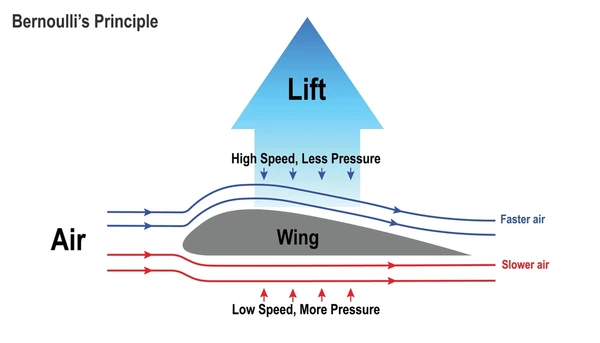
As you can see in the image above, vectors are drawn, representing force. We have to acknowledge that when the airplane moves at a sufficient speed, the “red vectors” are more “powerful” than the blue ones, so we fly. The force represented by these arrows is lift.
Ok, good. Now you also have to know that a plane generates “drag.” This drag is created by the formation of wingtip vortices. These result from the behavior of air and its interaction with the wingtips. The vortices are formed because of the same difference in pressure that allows the plane to fly. It’s basically twirling air that creates induced drag. This drag is a force that pulls in the opposite direction of the plane’s movement, like a slow brake. It’s actually terrible for plane companies, as it requires more fuel for the planes in order to counterbalance.
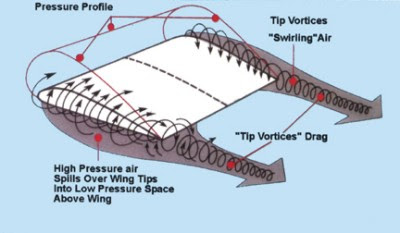
But when a plane approaches the ground, there is no more space for the vortices to form, or they are less powerful. Mathematically: reduced vortices = reduced drag = increased lift. And here you go, that’s what ground effect looks like! Because the air doesn’t have space under the wings to create vortices, it is “trapped” under them and creates a cushioning effect, lifting the plane because of reduced drag.
This effect can be really annoying and even dangerous for some planes and pilots if they aren’t trained. Imagine trying to land your plane on a track: you reduce your speed proportionally so you go down proportionally, and at the moment you think you’re going to touch the ground, you lift even though your speed has decreased. I also believe that some F1 formula cars are using this effect, but the other way around, and it should not be mixed up. While a plane’s ground effect is lifting the vehicle, an F1 formula car’s ground effect is gluing it to the track.
Thanks for reading this small article!
credits:
original research paper: Hyun, N. S. P., Chan, C. M., Hernandez, A. M., & Wood, R. J. (2025). Sticking the landing: Insect-inspired strategies for safely landing flapping-wing aerial microrobots. Science Robotics, 10(101), eadq3059.
videos and explanations of effect:
-
https://www.youtube.com/watch?v=XS_n9q9Lzwk
-
https://www.reddit.com/r/AerospaceEngineering/comments/149yvhg/what_exactly_is_ground_effect_in_f1_and_aircraft/?rdt=50300