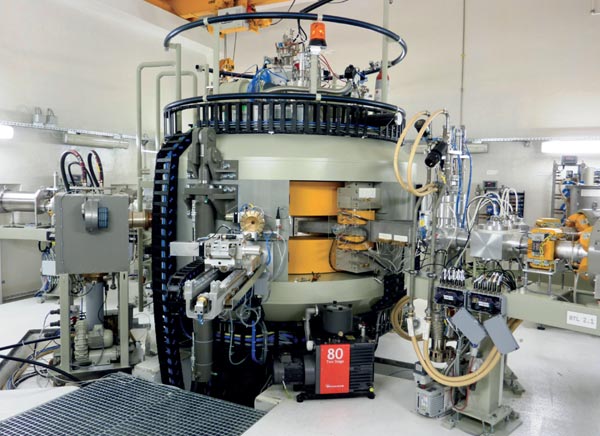
Hey! Sorry for last week’s article… I was re-making the whole website, so I didn’t have the time to write a new article. Hope you enjoy the new style!
So I’d like to talk about a physics instrument that I discovered in a physics exercise for school. At first I didn’t really catch how it worked, but now it’s clearer and I think it’s really mind-blowing, even though it’s hard to understand.
So, before even trying to explain what it is, we can ask ourselves: what are we trying to achieve? The final answer is to create radioisotopes (radioactive particles used in medicine) by sending a proton at a very high speed into a certain type of atom. I know it seems theoretical, but I can’t describe each atom or radioisotope because it really depends on what we are working on. Let’s just stick with one central goal: we want to accelerate a particle to a very, very high speed.
Now, imagine a charged particle. We have all learned in school that + is attracted by - and vice versa, right? Well, charged particles are atoms that are either + or -, meaning we can control their direction with an electrical field that has - or + plates. The concept here is that we’re going to send a charged particle into the center of an electrical field, so it will be attracted to a positive or negative part. The fact that it’s attracted already gives it speed because it moves toward the charged part.
But this velocity isn’t very high; we want to accelerate particles to a speed that we could actually compare to the speed of light! Therefore, we can switch the positive and negative sides of our electrical field producer by changing the frequency of the voltage, right? Yes, but by doing so we’re not accelerating; the particle will need to reduce its velocity to the point it’s not moving and then go to the other side.
That’s why we’re going to use something else: a magnetic field! See the image below to understand the way a cyclotron works.
NB: purple arrows represent the magnetic field, yellow the electrical field, and the red dot is our particle.
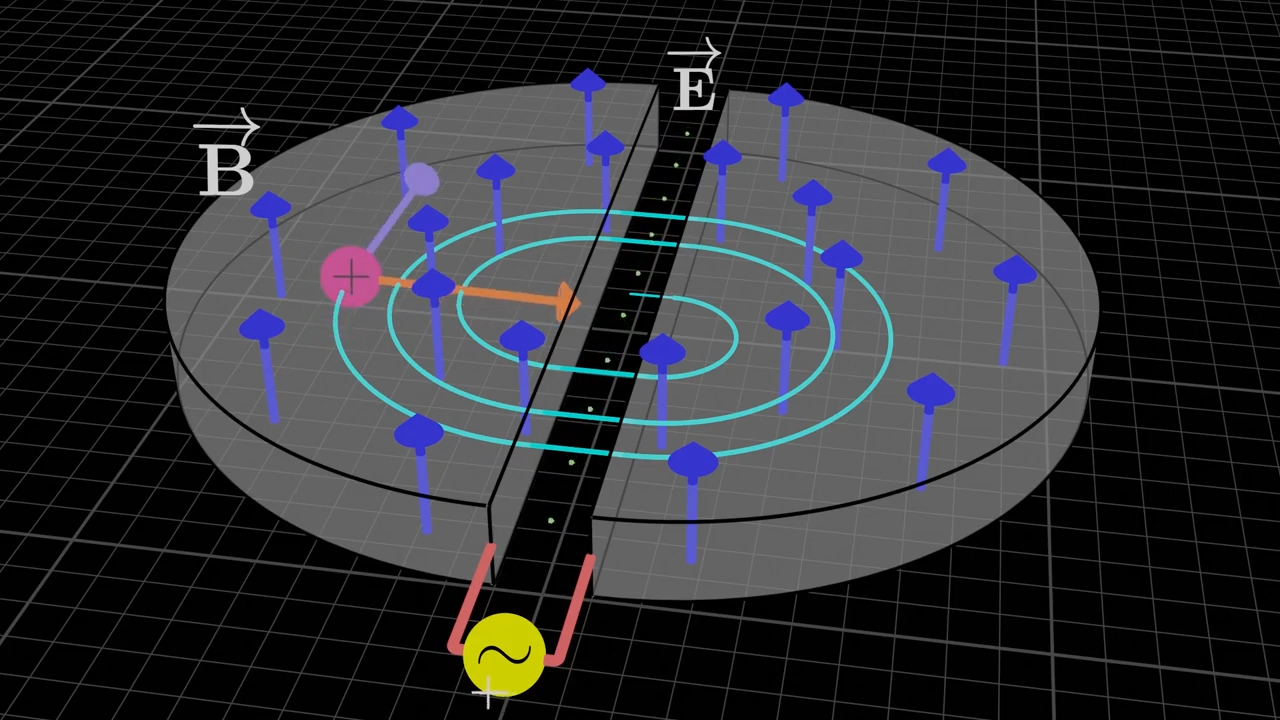
As you can see, the fact that we added a magnetic field and that the electrical field producer, the “dees” (grey discs on the image above), are hollow, which lets the particle move inside of them, is essential. We basically created an electrical/magnetic-field-made racetrack for charged particles.
Imagine you’re in a McLaren Speedtail car on a big racetrack. You want to use your twin-turbocharged V8 with a parallel hybrid system to its full capacity, so you’re going to circle around that track until you reach your final speed. That’s what we’re doing with a cyclotron, except that we are using electromagnetic fields and the racetrack increases in radius.
To finish with, let’s just assume a 1m radius cyclotron with a regular 1T magnetic field. We are sending an alpha particle; the final speed of our particle would be 48×10^6 meters per second. That’s literally 0.16c (16% of the speed of light). It’s so big that our human brain can’t actually process this info, and we can even believe that it’s not that much!
For the most curious: at max speed, the particle will hit an “extraction sheet” that will isolate a proton while letting it keep its speed, and it will be sent to a tube that will eventually send it to the target: the material that will produce radioisotopes.
Anyway, it’s funny to see how much we can learn from a physics exercise, and I found this cyclotron thing very interesting, although quite difficult to understand.
credits:
https://www.youtube.com/watch?v=m2jp0klZHEE&t=226s
https://www.youtube.com/watch?v=hHT3fjA0_xg (mainly)