I live in Paris, France, and here, almost 70% of our electricity comes from nuclear energy. Therefore, France is the country that is the most dependent on nuclear energy in the world. The French government made that choice because nuclear energy is reliable, constant, and efficient. Take a solar panel field, for example: if it’s rainy, no electricity; if it’s cloudy, no electricity; if it’s night, no electricity; if it’s winter, less electricity… Nuclear energy doesn’t have this issue, and in addition to its technical advantages, it’s almost carbon emission-free because the fission reaction that takes place in the core of the reactor doesn’t produce greenhouse gas.
So nuclear energy seems like the perfect solution for all of our global energy challenges, right? Well, apart from the fact that it’s expensive, it produces one type of very special waste. Indeed, the residues coming from the reaction are highly radioactive, and they will be for millions of years. This period of time is something that we can’t change or work on: it’s the laws of physics.
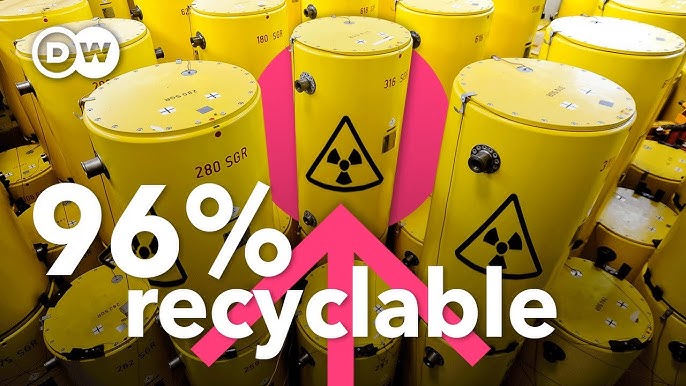
But here’s the strange twist: more than 90% of the energy in nuclear fuel rods remains when they are discarded! We just consider it as not (economically) efficient anymore. But what if we could recycle these rods and use the energy to start a nuclear reaction again? Almost 96% of the used nuclear rods around the world could still be used, yet no one’s taking part in this project.
How is it possible to recycle nuclear waste?
Well, first, we need to understand what we have at the end of the reaction. We’re left with three main components: plutonium, uranium, and fission products. Then, we need to separate these elements. Orano, the only company in France that recycles nuclear waste, does this by first dipping the rods into an acidic solution called a “dissolution solution.” This extracts the fission products from the plutonium and uranium.
NB: I’m really happy to see how they separate the different elements because I learned exactly this chemical technique in my chemistry class this year! I like to see the application of what we are learning at school in real life.
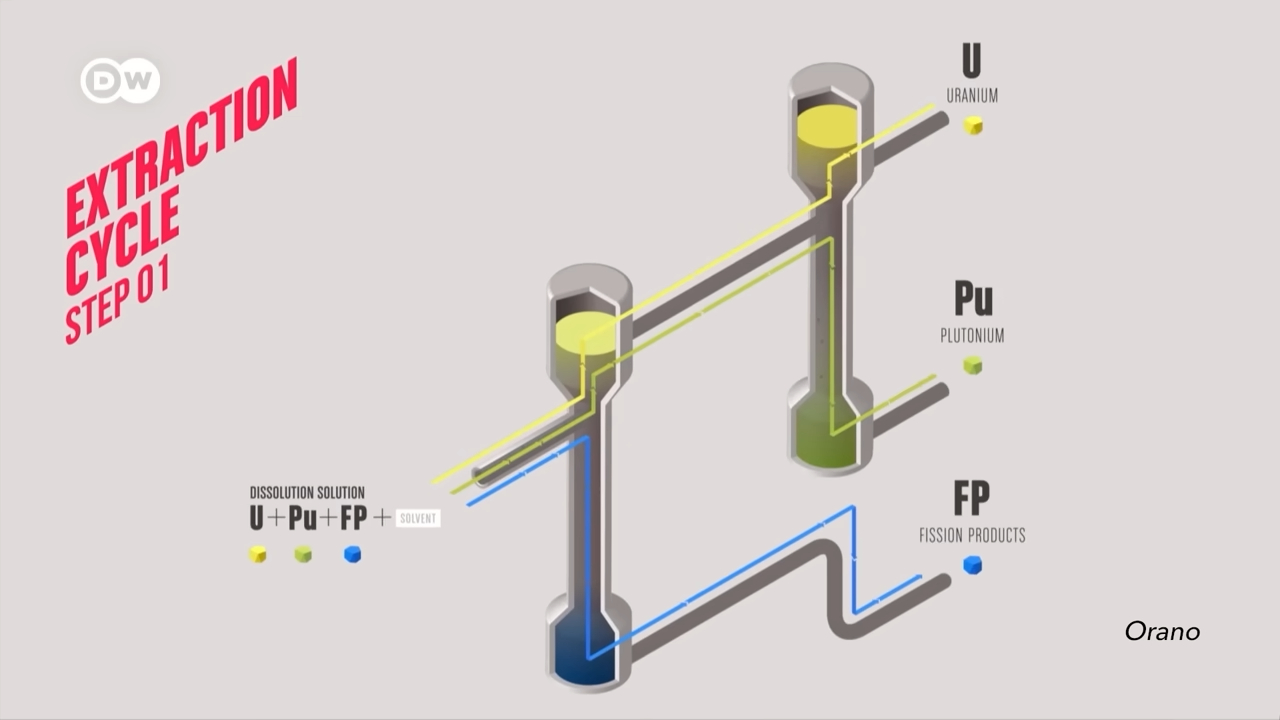
Then, we need to separate the plutonium and uranium, and we do this by adding another chemical that changes the state of plutonium, separating them. At the end of the process, we’re left with the three separated components. Four percent of them are fission products that are not usable, then there is uranium that will be re-used in nuclear plants instead of mining it, and purified plutonium. This last one is the troublemaker here because guess where humans are using purified plutonium? In nuclear weapons…
Imagine being a country that doesn’t have nuclear weapons but has nuclear plants and has access to this recycling process…
Oh, and if you were wondering, the fission products are still radioactive, but they are being vitrified and stored in deep concrete cylinders underground. We’re not going to discuss it here because it could be the subject of a whole other article.
I just found it cool how they are able to recycle the nuclear rods and re-use the uranium. It’s a costly process that few can do, more for economic than technical reasons. Yes, because that’s the last thing: it’s cheaper to destroy our ground by mining all of our uranium than recycling. And for all of this, France is the only country that is actively recycling its nuclear products, and I still find it positive, pushing us toward cleaner energy and a better future.
Credits:
https://www.youtube.com/watch?v=hiAsmUjSmdI