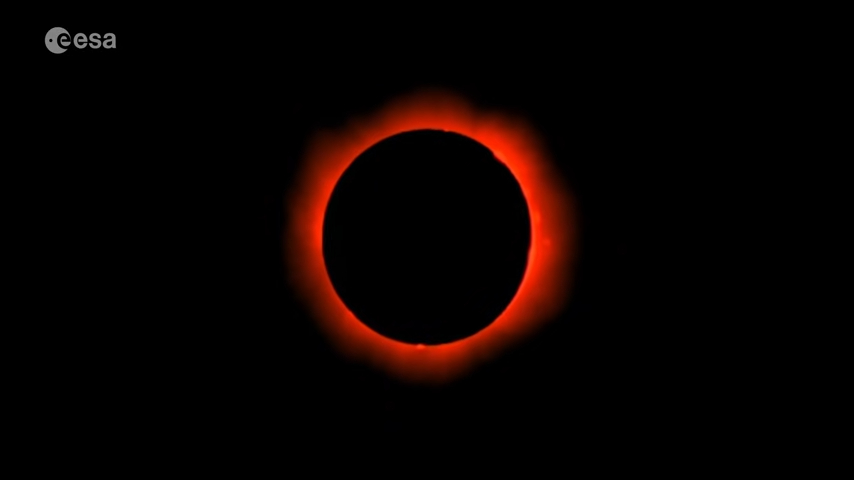
One day, I was on vacation in NYC with my family. I was little, and I remember going to the naval museum and being on the deck, watching a solar eclipse. This is a core memory for me, watching everyone being so concentrated on the Moon slowly passing in front of the Sun… It really felt like a magical, even mystical moment to me.
Total solar eclipses are rare astronomical phenomena that have the amazing characteristic of revealing the Sun’s corona, the outermost layer of its atmosphere, extending millions of kilometers into space. It’s important to know these natural events are extremely rare in any given location, appearing roughly once every 375 years, often in remote or difficult-to-access regions of the planet.
Understanding the corona is crucial for studying solar weather and the way energy moves in and around the Sun. To observe it without waiting centuries for an eclipse (which is nice :)), scientists developed an instrument: a coronagraph. It’s a device that mimics the effect of the Moon by blocking out the Sun’s bright light and allowing us to study its outer atmosphere.
Even though the coronagraph is a very nice instrument, we are still facing several problems. For instance, there’s the coronal heating problem: the Sun’s surface (the photosphere) has a temperature of about 5,500°C, but the corona is mysteriously much hotter, ranging from 1 to 3 million degrees Celsius!!!
Scientists still don’t fully understand how this extreme temperature difference is possible because it changes everything we know about the way energy is transferred from the surface into the corona.
Also, the corona is responsible for powerful solar phenomena like geomagnetic storms and coronal mass ejections, which can affect satellites, GPS, and even power grids on Earth, possibly causing a whole blackout. And that’s not it! The hardest region to observe from the corona is between the low and high corona.
That’s why scientists created Proba-3, a mission involving two spacecraft designed to simulate solar eclipses in space — yes, only that. And they do so far more often than nature allows: Proba-3 is able to study the corona for about 6 hours during each 19-hour and 36-minute orbit.
Here’s how it works: two satellites fly in formation. One, known as the “occulting” (called the mask) satellite, blocks the Sun’s light, casting a shadow onto the second “observing” satellite. This setup replicates a total eclipse, giving scientists a clear view of the corona.
The mask satellite also carries an instrument to monitor the Sun’s total energy output, known as solar irradiance, which is a key factor in climate studies.

Scientists chose an elliptical orbit for this mission rather than a low Earth orbit. This is because low orbits involve stronger gravitational forces, more atmospheric drag, and light reflections from Earth that would interfere with measurements. The elliptical orbit stretches from 600 km at its closest point to 60,000 km at its farthest, where the spacecraft moves more slowly, which gives more time for observations when closest to the Sun (smart, isn’t it?).
During most of the orbit, the satellites fly close together in a sort of standby mode (close to each other but not aligned), and as they approach the observation zone, they receive a signal and begin a 2-hour repositioning sequence to form the perfect eclipse alignment.
It doesn’t seem like it, but maintaining this precision is extremely challenging… The satellites experience small gravitational perturbations, and over time, they will slowly drift and eventually re-enter Earth’s atmosphere (in 4 years). Imagine flying two spacecraft in such tight synchronization (only 150 meters apart)… it’s literally a world first! Thanks to an automated system using cameras, lasers, and radio signals, they can maintain a formation with 1-millimeter precision, minimizing the risk of collision.
To me, this is the craziest part. Of course, I love the idea of sending two satellites with one casting a shadow on another one — it’s already an innovation — but doing so with such precision truly intrigues me.
On Earth, studying the corona with this level of detail is nearly impossible because of diffraction, a natural effect that scatters light and blurs the view. Proba-3’s design overcomes this limitation by operating outside the atmosphere, offering a clean, stable view of the Sun’s corona.
Credits:
https://www.esa.int/esatv/Videos/2024/12/Creating_artificial_eclipses_to_study_the_Sun_Proba-3_explained