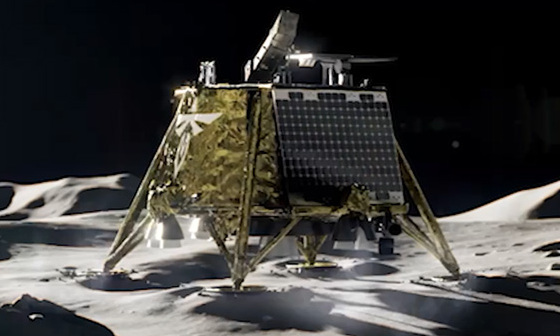
While scrolling through the news, I came across the Blue Ghost mission as an astronomy fan, and its launch on January 15 (2025)…
Blue Ghost is definitely shaping up to be one of the most exciting space adventures of the past few years! It’s a lunar lander developed by Firefly Aerospace, a private company based in Texas, and what makes it particularly interesting is that it’s part of NASA’s Artemis program. Its main goal is to explore the lunar environment and gather crucial data to help prepare for a sustainable human presence on the Moon. On March 2, 2025, it made history by becoming the first private American lander to successfully touch down on the lunar surface. This event marks a major milestone in space exploration—not just because it proves private companies can pull off such complex missions, but also because it paves the way for new collaborations between government agencies and the private sector.
The Blue Ghost lander carries a set of scientific and technological instruments that will operate for about fourteen Earth days—the length of a lunar day. One of the most impressive devices onboard is the Next Generation Lunar Retroreflector, designed to reflect laser pulses sent from Earth and measure the Earth-Moon distance with sub-millimeter precision. This advancement greatly improves space navigation and could even be useful for future Mars missions. Another groundbreaking technology on board is the Lunar GNSS Receiver Experiment, which successfully picked up GPS and Galileo signals from lunar orbit—a record-breaking 396,000 kilometers away. After landing, its role is to receive GNSS signals directly from the lunar surface, a first-of-its-kind achievement that could revolutionize navigation for future space missions. The lander is also equipped with the Lunar Environment Heliospheric X-ray Imager, designed to capture X-ray images of Earth’s magnetosphere from the Moon. These images will help scientists better understand space weather and its effects on the lunar environment—crucial information for ensuring the safety of future crewed missions.
On top of these innovations, Blue Ghost carries the Stereo Cameras for Lunar Plume-Surface Studies, a system designed to record the lander’s descent and analyze how its thrusters interact with the lunar surface. These observations are key to improving landing techniques and minimizing surface disturbances for future missions. Another major breakthrough of this mission is the Electrodynamic Dust Shield, a technology that uses electric fields to prevent lunar dust from sticking to equipment surfaces. Lunar dust is a huge problem for long-term operations—it’s extremely abrasive and can damage instruments and spacesuits. If successful, this system could be a game-changer for sustainable lunar exploration. The mission also includes experiments on heat flow and lunar regolith analysis, with sensors designed to measure the thermal and electromagnetic properties of the Moon’s crust, providing brand-new insights into its geological evolution.
One of the most anticipated moments of the mission is the observation of a total solar eclipse from the lunar surface on March 14, 2025, followed by sunset on March 16. These events will be recorded with unprecedented precision and will provide valuable data on lunar dust dynamics and mysterious light phenomena seen on the lunar horizon. These phenomena were first spotted during the Apollo 17 mission and remain largely unexplained—Blue Ghost’s new data could finally offer clear answers. This mission is far more than just a landing—it’s a major step forward in our understanding of the Moon and in preparing for future crewed missions.
What makes Blue Ghost so exciting, beyond its technological feats, is the clear demonstration that space exploration is no longer exclusively dependent on large government agencies. Today, private companies like Firefly Aerospace are playing a crucial role in this new era of exploration, opening up endless possibilities for future generations of engineers and scientists. Personally, seeing missions like this come to life only strengthens my desire to one day contribute to this field. Blue Ghost is more than just a lunar lander—it’s proof that human ingenuity knows no limits and that we’re standing at the dawn of a revolution in space exploration.